








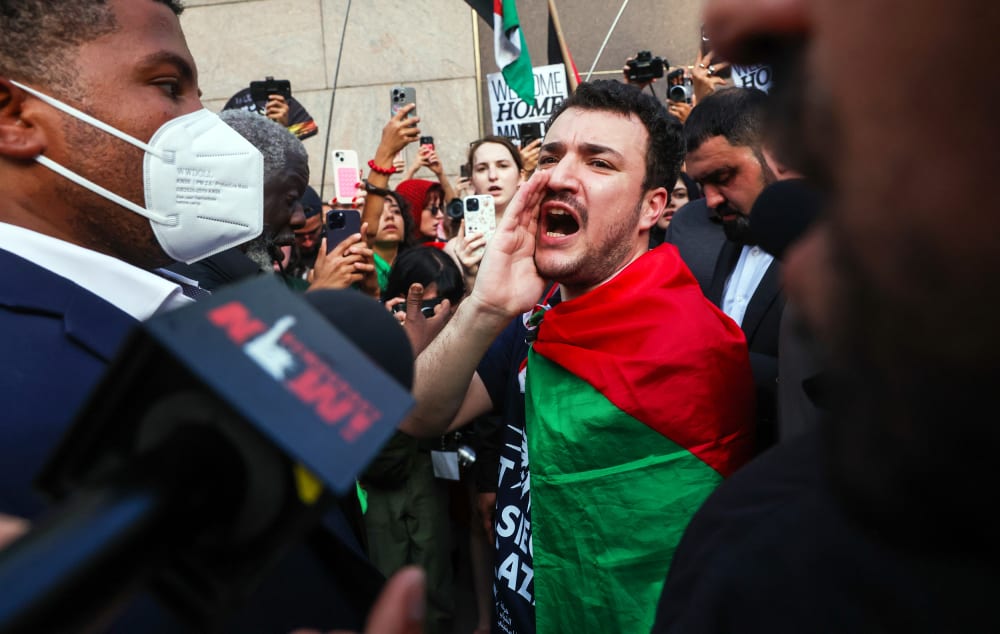
U.S. District Judge William G. Young called President Donald Trump “authoritarian” this month and took his administration to task for trying to deport students who’ve engaged in speech the government opposes. Young, a Reagan appointee, described the federal government as engaging in an “unconstitutional conspiracy” to “twist the laws” and “pick off” well-known activists in order to intimidate all noncitizens across academia.
Imagine if my fellow university presidents had the backbone Judge Young displayed.
Imagine if my fellow university presidents had the backbone Judge Young displayed. When the administration was snatching students off the street for taking political stances the administration considers problematic, imagine if those higher education leaders had stood up to say publicly that the president’s charge of antisemitism was a smokescreen for his attempts to change how colleges and universities admit students and teach them.
Although the administration has a duty to enforce civil rights laws that protect all students from harassment and discrimination, it is also the case that the government failed to follow its own protocols of investigation and adjudication in these matters. Everyone at the schools that have made “deals” with the administration knows this, just as they know that the real issue was never about protecting Jewish students, women’s sports or objectivity in fields such as Near Eastern Studies.
But instead of saying clearly what they really knew, university leaders at so many schools made deals and paid fines while others peremptorily did away with programs that were not in line with the preferences of the president.

University presidents were not alone in their appeasement. We’ve seen law firms and media executives do the same.
The heads of some prominent law firms could have — and should have — publicly denounced the administration’s attempts to interfere with the legal system’s core principles and defended clients who might not agree with the administration, but instead many promised to “donate” millions of dollars of pro bono legal work to the president’s favorite causes.
Of course, resistance would have meant having to fight the administration’s executive orders in the courts, which would have been expensive. But these are prominent attorneys, after all. Instead of defending the rule of law, the firms made deals that helped preserve their partners’ wealth.
University presidents were not alone in their appeasement.
ABC temporarily suspended late-night talk show host and comedian Jimmy Kimmel for a comment he made after Charlie Kirk was killed, but imagine if the network’s executives had made clear that they would not be intimidated by Federal Communications Commission threats against Kimmel or Trump’s vow to take away broadcast licenses of those who in his mind gave “him only bad publicity or press.” Instead, in the hope of escaping the government’s crosshairs, they capitulated with a suspension of Kimmell — however brief — and gave in to the preferences of the president.
That’s why Judge Young’s words this month are so powerful. We should receive those words as his refusal to participate in the Trump administration’s duplicitous descriptions of current events. That same week, Federal Reserve Chair Jerome Powell had also done the same. When the Justice Department announced that it was pursuing a criminal investigation of the Federal Reserve because of cost overruns at its renovated headquarters, Powell recorded a video message saying out loud what other beleaguered leaders have been silent about: that the government’s investigations were just a cover for punishing someone failing to satisfy the Trump administration.

As Powell put it, “The threat of criminal charges is a consequence of the Federal Reserve setting interest rates based on our best assessment of what will serve the public, rather than following the preferences of the president.”
We don’t have to imagine why, instead of fighting back, some prominent leaders of law firms, media companies and universities have chosen to issue statements about how they can improve their procedures, cultivate respect and fairness or work to restore trust in their institutions. The threats from the White House and the Justice Department are real, and the federal government has enormous powers — especially when it doesn’t follow its own rules or adhere to conventions of fairness. Americans now know that the president feels his only limitation is his own mind and his own morality, and that his chief advisor believes in the iron laws of strength. Leaders of institutions in the president’s crosshairs have good reason to be afraid. I don’t know if Powell and Young are afraid, but they didn’t back down. They didn’t accept the nonsense put before them and instead chose to speak frankly and directly. They are well-aware, as are now elected officials in Minnesota, that the price one pays for defying the preferences of the president can include being placed under criminal investigation. I don’t know if Powell and Young are afraid, but they didn’t back down. But the price of allowing the preferences of any president to dictate the policies and practices of organizations that depend on freedom and autonomy is to destroy the legitimacy of those organizations. The price of letting any president rule over the country with no limitations but his own mind is the destruction of our democracy. Powell said that “public service sometimes requires standing firm in the face of threats.” Judge Young has written that his sense of duty prevents him from acquiescing in “political persecution…anathema to our Constitution and everything for which America stands.” Some law firms are challenging Trump’s administration, while many career prosecutors are resigning rather than helping carry out Trump’s agenda, including his most recent attempts to smear the name of ICE shooting victim, Renee Nicole Good. And although many university presidents are accommodating the president by cloaking themselves in neutrality, other higher education leaders, including those at George Mason, Princeton, Bard, Harvard and Mount Holyoke, are resisting federal pressure. I have no idea if the Federal Reserve chair is on the right path in regard to interest rates, or if Judge Young’s approach to free speech will prevail at the Supreme Court, but I am sure they have chosen paths of integrity in the face of an increasingly authoritarian White House. The health of our educational sector and of our democracy may well depend on how many other institutional leaders make that same choice.
Michael S. Roth is president of Wesleyan University and the author of “Safe Enough Spaces: A Pragmatist’s Approach to Inclusion, Free Speech, and Political Correctness on College Campuses” and “The Student: A Short History.” 

