








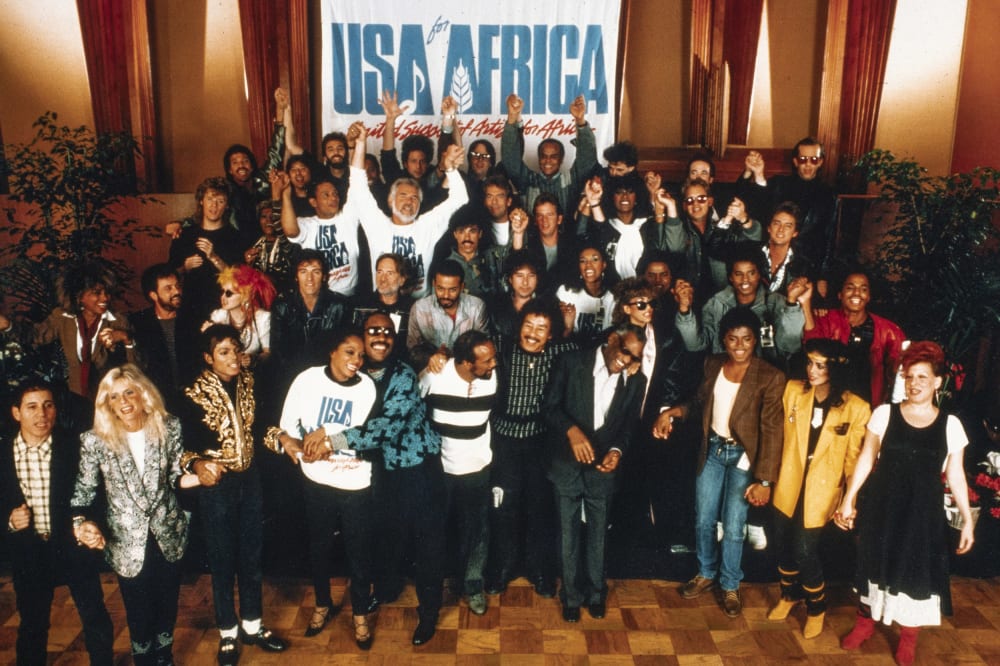
If you haven’t spent the last several years, as I have, deep-diving into the history of the 1985 charity megahit “We Are the World,” then you probably don’t know that Stevie Wonder invited two Ethiopian famine survivors to the stuffy Los Angeles studio where dozens of superstar pop artists had gathered for a one-night-only shot at getting the song on tape.
You certainly wouldn’t know about the Ethiopian women’s appearance from watching “The Greatest Night in Pop,” the entertaining, if self-congratulatory, new Netflix documentary about the hit, which was the brainchild of Harry Belafonte, co-written by Michael Jackson and Lionel Richie and masterfully shepherded into existence by producer Quincy Jones.
Stevie Wonder invited two Ethiopian famine survivors to the stuffy Los Angeles studio where dozens of superstar pop artists had gathered.
The women, one of whom is featured briefly in an early documentary about the recording, put faces to the cause and, according to reports at the time (in which they are regrettably not named), impressed upon the celebs the gravity of what was happening in their country. (My own attempts to determine those women’s names have come up short. Wonder introduces one of the women by name in that 1980s documentary, but I can’t make out what it is.)
Though many of the stars had no real idea what they’d agreed to before they arrived at the studio, it’s clear from the 1985 film’s footage showing the tearful aftermath of the women’s 4 a.m. appearance that the group was deeply moved by their presence and words of appreciation.
However, in “Greatest Night,” the honor of imparting the story of the Ethiopian famine on Michael Jackson and the gang is given to Bob Geldof, the Irish rocker who was riding high on “Do They Know It’s Christmas?” a charity anthem he co-wrote after seeing a BBC news report about the Ethiopian famine, which was part of the inspiration for “We Are the World.”
The Ethiopian women’s absence in “Greatest Night” and their persistent anonymity despite the core role they played in the production of “We Are the World” are emblematic of the well-intentioned but complicated legacy of the recording and of a celebrity charity industrial complex that can sideline and sometimes silence the people it is supposed to benefit.
Featuring solos from Ray Charles, Bob Dylan, Dionne Warwick, Willie Nelson, Tina Turner, Bruce Springsteen, Cyndi Lauper and other icons of the ’80s, “We Are the World” popularized a genre-busting cultural phenomenon — the star-studded celebrity collab.
While most Western pop music historians would probably say 1971’s Concert for Bangladesh was the first supergroup awareness event of its kind, “We Are the World” seems to have both broken and created the mold. For all its revolutionary promise and appeal, the approach celebrities have used to raise public awareness and money hasn’t changed much since the 1980s; it has, instead, been the subject of much imitation, reimagination and mockery. In 1985 alone there was Geldof’s Live Aid and the Canadian “Tears Are Not Enough,” both benefiting Ethiopian causes, plus Farm Aid, concerned with hunger in the U.S., and “Sun City” from Artists United Against Apartheid.

The Ramones, featuring Weird Al and edgier, less mainstream artists, spoofed “We Are the World” with 1986’s video for “Something to Believe In.” In 2010, Richie and Haitian American rapper Wyclef Jean were among the executive producers of a 25th anniversary edition of “We Are the World” for earthquake relief in Haiti, with an updated list of star performers including Justin Bieber and Jamie Foxx. More recently, the world was subjected to a cringey, Covid-fueled celebrity singalong to John Lennon’s “Imagine” and multiple reinterpretations of “We Are the World” involving average folks and D-list celebrities.
I got interested in the “We Are the World” origin story and cultural legacy about 10 years ago, following a night of whiskey-fueled karaoke with my husband, a fellow elder millennial. He’d had the poster — you know the one, with all the celebs on the risers and the blue scripty-font logo — on his wall as a kid, and I’d had a lifelong affinity for the song thanks to my Springsteen-obsessed mom.

It makes sense. We’re the kind of privileged, Western (and white) people whose heartstrings (and wallets) “We Are the World” was created to tug at. But once he and I started looking — we aim to produce a podcast about the song someday — we found a dozen more threads to pull on. One is “We Are the World’s” roots in the civil rights work of Belafonte, who had originally imagined a project by and featuring Black artists. Yet another thread is the recording of the song during the Reagan era and in a geopolitical landscape in which the United States’ anti-communist, Cold War paranoia played a key role in manipulating the politics of the Ethiopian famine.
Then there’s the international humanitarian angle, especially the explosion of American and European nonprofit groups and NGOs involved in Ethiopian affairs and across the continent. In many ways, that response helped flatten “Africa” into an amorphous continent-slash-country in perpetual need of rescue from well-meaning Westerners. ‘We Are the World’ created a model for feel-good fundraising that gives back to the giver without demanding we look too closely at the problem at the heart of it all. “We Are the World’’ created a model for feel-good fundraising that gives back to the giver without demanding we look too closely at the problem at the heart of it all or even at the lived realities and demands of the people in need of help. This is, of course, a huge part of its success and a reason the “We Are the World” tropes are so easily and often imitated and re-created. It doesn’t hurt that the song itself is great. (This is a hill I will die on.) It’s cheesy and corny, but nevertheless, it’s a thrill to listen to. It’s certainly a world of improvement over the patently offensive “Do They Know It’s Christmas?” USA for Africa, the “We Are the World” legacy nonprofit group, continues work across Africa today, and it has raised hundreds of millions of dollars. But more expressly political pop culture protest and resistance events and artifacts have never quite captured the mass global popular imagination — or funding zeitgeist — the way “We Are the World” did. The resurgence of interest in “We Are the World” as we approach the song’s 40th anniversary is a good opportunity to ask ourselves why and what we might do about it. Of course, it’s unfair to hold the artists behind a 39-year-old song to the sociocultural and political standards of 2024, but surely we can hold ourselves to today’s standards and push for new conversations about nonprofit fundraising, international aid and philanthropy. The shift is already toward political and civic engagement and redistributing wealth and decision-making power to people who are the most affected, not the most privileged. But it’s slow going, perhaps in part because charity-over-solidarity models like the one embodied by “We Are the World” are the ones preferred by the most comfortable of us. Because they ask the least of us.
Andrea Grimes
Andrea Grimes is a journalist and activist living in Austin, Texas. 

