



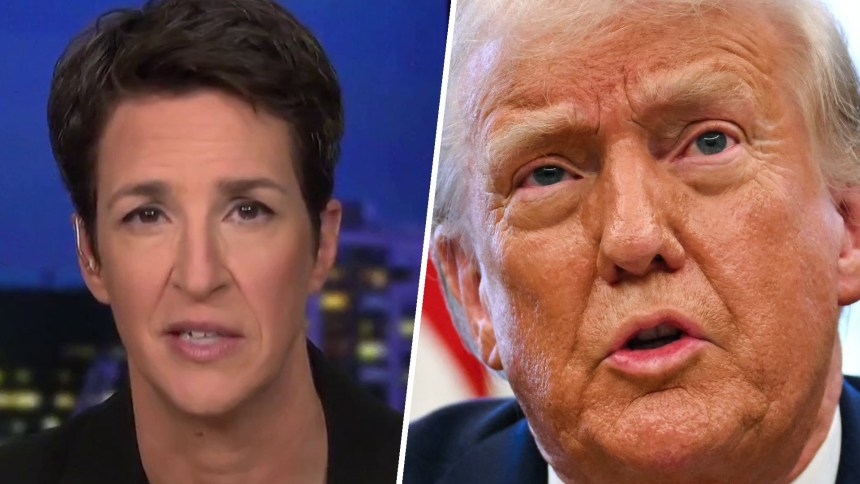


This is an adapted excerpt from the March 10 episode of “The Rachel Maddow Show.”
It started with an advertisement in The New York Times. On March 29, 1960, the paper ran a full-page ad soliciting donations for Martin Luther King Jr. and for the college students in the South who were fighting segregation.
As Enrich described, the Sullivan decision “helped usher in a new age of American journalism.”
The fundraising appeal, entitled “Heed Their Rising Voice,” listed numerous ways in which the students were allegedly being harassed and terrorized. It also accused Southern officials of committing acts of violence and intimidation and violating the U.S. Constitution.
Soon, L.B. Sullivan, a city commissioner in Montgomery, Alabama, one of the cities mentioned in the ad, filed a lawsuit against The New York Times, accusing the paper of libel. Although he was not named in the ad, Sullivan claimed the Times had defamed him — a Southern official — because, he said, some details in the ad were exaggerated or incorrect. At the time, a headline in the local Montgomery paper summed it up this way: “State Finds Formidable Legal Club To Swing at Out-of-State Press.”
In his new book, “Murder the Truth: Fear, the First Amendment and a Secret Campaign to Protect the Powerful,” New York Times reporter David Enrich describes what happened next:
Sullivan’s lawsuit went to trial in the Montgomery courtroom of Judge Walter Jones, who maintained segregated seating, was a devout promoter of all things Confederacy, and believed in what he called “white man’s justice.” … As the Sullivan trial was about to get underway, some prospective jurors showed up to court in Confederate costumes, toting pistols … It took the jurors barely two hours to return a verdict against the Times. The newspaper was ordered to pay Sullivan $500,000. It was the largest libel judgment in the state’s history.
“For racist Southerners, this was the equivalent of a green light,” Enrich writes. “The courts could be used to scare the press into silent submission … The Times, fearing a tidal wave of litigation, barred its reporters from setting foot in Alabama, and its lawyers urged staff members not to write articles about the state’s racism.”
But that was not the end. The Times eventually got its case with Sullivan before the United States Supreme Court. And in 1964, the Supreme Court surprised everybody with a landmark, unanimous decision that would change journalism in this country forever.
Recommended


In the simplest terms, the court ruled that there cannot be free speech and a free press if news outlets can be sued into oblivion over mistakes or good-faith errors. The court established a new standard: A public figure suing a media outlet for libel would have to prove that the outlet knowingly lied, or acted with reckless disregard for the truth.
As Enrich describes, the Sullivan decision “helped usher in a new age of American journalism devoted to exposing malfeasance, questioning authority and promoting the public interest.” He writes that shortly after the court’s ruling:
Reporters uncovered wrongdoing in Vietnam, the White House, and the Pentagon. It was not a coincidence that the Washington Post cracked open Watergate in the years after Sullivan; if the burden of proof in a defamation case had still rested with the defendant, and if even honest mistakes had remained punishable under the law, the costs of publishing such a series of investigations might have been prohibitive. (As his presidency circled the drain, Richard Nixon blamed Sullivan and had his administration craft legislation that he hoped would supersede the precedent and put the media back in a pen.)
Nixon did not succeed at putting the media back in a pen. But he would not be the last to try.
More than six decades after the Supreme Court’s landmark decision in New York Times Co. v. Sullivan, Enrich makes a compelling and alarming case that the legal protections that undergird the free press in this country are on much shakier ground than we may realize.
- Trump and his allies make no secret of their desire to criminalize the media, with constant attacks on the press as the enemy and an explicit campaign promise from Trump that he would somehow “open up” the nation’s libel laws. Trump has already sued several media outlets and his billionaire supporters have also threatened to launch aggressive legal attacks of their own. These lawsuits risk bankrupting those outlets and shutting them down, something Trump’s allies have had some success with in the past. And a once-fringe right-wing idea, that the whole Sullivan precedent could be overturned, is now publicly supported by two Supreme Court justices, Neil Gorsuch and Clarence Thomas.
The attack on this foundational protection for the free press in this country has been a long time coming. But it looks like it may have finally arrived.

Rachel Maddow
Rachel Maddow is host of the Emmy Award-winning “The Rachel Maddow Show” Mondays at 9 p.m. ET on MS NOW. “The Rachel Maddow Show” features Maddow’s take on the biggest stories of the day, political and otherwise, including in-depth analysis and stories no other shows in cable news will cover.

Allison Detzel is an editor/producer for MS NOW. She was previously a segment producer for “AYMAN” and “The Mehdi Hasan Show.”
Latest Post